Sizing guide
How to size a battery for your home or solar system
A step-by-step method to work out how many kWh you need, which system voltage to use and which Powrio LiFePO₄ pack fits — with a worked example.
6 min readUpdated By the Powrio engineering team
Buying a battery by its ‘Ah’ number alone is how people end up with backup that dies halfway through a power cut. Sizing properly takes four numbers: what you want to run, for how long, at what system voltage, and how much of the battery you can really use. Here is the method our engineers use.
Step 1 — List what must run
Write down each appliance you need during an outage (or after sunset, for solar) and its power in watts. The rating plate or manual lists it. Be realistic — backup for everything in the house is rarely needed.
| Appliance | Typical power |
|---|---|
| Ceiling fan (BLDC / standard) | 30 W / 75 W |
| LED tube or bulb | 9–20 W |
| Wi-Fi router | 10–15 W |
| LED TV (43") | 60–100 W |
| Refrigerator (average while cycling) | 100–150 W |
| Desktop computer + monitor | 150–250 W |
| Water pump (0.5 HP) | ≈ 375 W while running |
Step 2 — Convert power to energy
Energy is power multiplied by time. Multiply each appliance's watts by the hours it will run, then add them up. The result is in watt-hours (Wh); divide by 1,000 for kWh.
Energy needed (Wh) = Σ (appliance watts × hours of use)
Step 3 — Allow for usable capacity and losses
You should not plan to drain any battery to zero, and the inverter loses some energy converting DC to AC. For LiFePO₄ we plan on about 80% of rated energy as usable, then allow roughly 10% for inverter losses.
Battery rated energy (kWh) ≥ Energy needed ÷ 0.8 ÷ 0.9
Step 4 — Match the system voltage
The battery's nominal voltage must match the inverter. As a rule, higher-power systems use higher voltage so current — and cable size — stays manageable.
| System size | Common voltage | Powrio series |
|---|---|---|
| Up to ~1 kW | 12 V | 12.8 V — PB128100, PB128200 |
| ~1–2 kW | 24 V | 25.6 V — PB256100, PB256200 |
| ~2 kW and above, telecom | 48 V | 48 V — PB480100 |
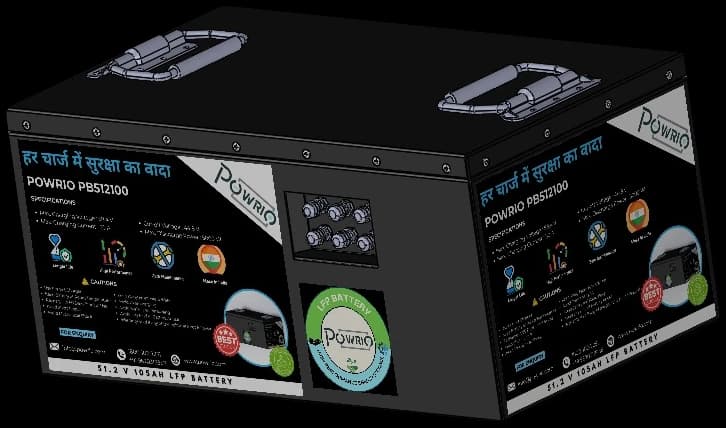
| Hybrid solar inverters | 48 V class (51.2 V) | 51.2 V — PB512100, PB512200 |
| Commercial high-voltage systems | 128 V (HV) | High-Voltage — PBHV1280100 |
Worked example
A family wants four hours of backup for 4 fans (75 W each), 6 LED lights (12 W each), a Wi-Fi router (12 W), a TV (80 W) and the refrigerator (120 W average).
- Load: 300 + 72 + 12 + 80 + 120 = 584 W
- Energy: 584 W × 4 h ≈ 2,336 Wh ≈ 2.34 kWh
- Rated energy needed: 2.34 ÷ 0.8 ÷ 0.9 ≈ 3.2 kWh
- Their inverter is 24 V, so the right choice is the PB256200 (25.6 V, 5.12 kWh) — with headroom for longer cuts.
Sizing for solar
For solar storage, size for the energy you use between sunset and sunrise (or until the grid returns), and check that your panels can refill the battery during an average day. A useful rough check: in much of India, each kW of panels produces around 4 kWh on a clear day, before losses.
Before you buy
- Confirm the inverter supports a lithium charging profile or adjustable charge voltage.
- Check the inverter's charge current and your peak load against the pack's max. charging current and max. discharge power.
- Plan a dry, ventilated location away from direct sun.
- Keep your purchase invoice and register the battery online on installation day.
Not sure? Send your appliance list and inverter model to our team — we will recommend a model and configuration free of charge.